


Things You Need for Your Grid-Tied Solar Plus Battery Back-Up System

We live in exciting times where power is available across most of the country to help you carry on with your day to day life easily. From homes and offices to shops and factories and hotels, power has revolutionized the way life is lived and enjoyed. And thanks to renewable energy sources like the sun, it is no longer necessary to burn fossil fuels to generate electricity and harm the environment. Problems of load-shedding or power cuts are easily handled too,with the help of advanced power backup systems.
Why go solar for power?
Driven by rapidly escalating power tariffs, and a pressure to shift away from fossil-fuel based energy, there are cleaner (than diesel generators of yesteryears) and cheaper alternatives now available to meet the power needs of your household. Solar power is driving the change, especially in India, with its abundant sunshine.
The diagram below represents an optimal solution, with the added peace-of-mind of a back-up. For discussion we take a household system as an example.The principle applies equally to commercial/industrial use as well.
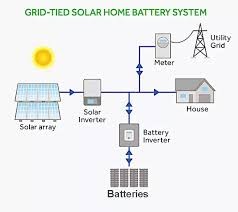 A close look at grid-tied solar system
This grid-tied system connects your household solar system to the power supply grid. Your panels feed electricity into the grid, and the utility credits your account for the power you generated. You can draw on that power whenever you need it (at night, for example, when panels aren’t producing energy from the sun). This system enjoys two benefits.
One: With a system of net-metering, you pay only for the excess power, if any, used from the grid, compared to what your solar panels generated.
Two: More importantly, the grid acts as a backup when your panels stop generating electricity for whatever reason.
Sounds perfect? Not entirely. Unfortunately, we are in a less than optimum situation and grid power can experience failure for various reasons, including extreme weather conditions. Not just in India, this is happening increasingly across the world. So, it is best to have a further backup battery system. Secondly, during cloudy conditions and at night time, the solar system needs a backup in the event of grid failure.
What are the requirements and things to keep in mind? These are discussed below.
Meter: Your domestic meter will have to be changed to allow for net-metering or two-way metering.
Solar Inverter: Your panels generate direct current (DC) while most appliances run on alternating current (AC). Hence, an inverter is needed to convert DC to AC. More importantly, this will synchronize the phase and frequency of the current to fit the utility grid. The output voltage is also adjusted slightly higher than the grid voltage to allow excess electricity to flow outwards to the grid.
Battery Inverter: To convert DC from batteries to AC
Furthermore, you would need a charge controller if your battery inverter does not have this inbuilt. To protect your battery from overcharging, it regulates the rate of current being delivered to the battery bank.
Once set up, you will enjoy a major cost advantage of avoiding peak load tariffs since you have paired a battery bank with the grid-tie inverter. In India, the Joint Electricity Regulatory Commission has stipulated TOD (time of day) tariffs, defining 6pm-10pm as the evening peak time attracting higher rates (10pm-6am is the off-peak period and 6am to 6pm normal). This billing is will be implemented fully overtime. Your battery bank can insulate you from this as energy stored during the day is used during evening.
Having understood this basic infrastructure, you can now approach a leading vendor like Genus to guide you and set up the entire system from start to finish.
Ask them, or do more homework first on the three main things to consider while choosing a solar system:
1. How much energy can my batteries store?
2. How much energy will my appliances use in a typical day?
3. How much energy can a Solar panel generate over the same period?
When this is done, contact Genus.
A close look at grid-tied solar system
This grid-tied system connects your household solar system to the power supply grid. Your panels feed electricity into the grid, and the utility credits your account for the power you generated. You can draw on that power whenever you need it (at night, for example, when panels aren’t producing energy from the sun). This system enjoys two benefits.
One: With a system of net-metering, you pay only for the excess power, if any, used from the grid, compared to what your solar panels generated.
Two: More importantly, the grid acts as a backup when your panels stop generating electricity for whatever reason.
Sounds perfect? Not entirely. Unfortunately, we are in a less than optimum situation and grid power can experience failure for various reasons, including extreme weather conditions. Not just in India, this is happening increasingly across the world. So, it is best to have a further backup battery system. Secondly, during cloudy conditions and at night time, the solar system needs a backup in the event of grid failure.
What are the requirements and things to keep in mind? These are discussed below.
Meter: Your domestic meter will have to be changed to allow for net-metering or two-way metering.
Solar Inverter: Your panels generate direct current (DC) while most appliances run on alternating current (AC). Hence, an inverter is needed to convert DC to AC. More importantly, this will synchronize the phase and frequency of the current to fit the utility grid. The output voltage is also adjusted slightly higher than the grid voltage to allow excess electricity to flow outwards to the grid.
Battery Inverter: To convert DC from batteries to AC
Furthermore, you would need a charge controller if your battery inverter does not have this inbuilt. To protect your battery from overcharging, it regulates the rate of current being delivered to the battery bank.
Once set up, you will enjoy a major cost advantage of avoiding peak load tariffs since you have paired a battery bank with the grid-tie inverter. In India, the Joint Electricity Regulatory Commission has stipulated TOD (time of day) tariffs, defining 6pm-10pm as the evening peak time attracting higher rates (10pm-6am is the off-peak period and 6am to 6pm normal). This billing is will be implemented fully overtime. Your battery bank can insulate you from this as energy stored during the day is used during evening.
Having understood this basic infrastructure, you can now approach a leading vendor like Genus to guide you and set up the entire system from start to finish.
Ask them, or do more homework first on the three main things to consider while choosing a solar system:
1. How much energy can my batteries store?
2. How much energy will my appliances use in a typical day?
3. How much energy can a Solar panel generate over the same period?
When this is done, contact Genus.
A close look at grid-tied solar system
This grid-tied system connects your household solar system to the power supply grid. Your panels feed electricity into the grid, and the utility credits your account for the power you generated. You can draw on that power whenever you need it (at night, for example, when panels aren’t producing energy from the sun). This system enjoys two benefits.
One: With a system of net-metering, you pay only for the excess power, if any, used from the grid, compared to what your solar panels generated.
Two: More importantly, the grid acts as a backup when your panels stop generating electricity for whatever reason.
Sounds perfect? Not entirely. Unfortunately, we are in a less than optimum situation and grid power can experience failure for various reasons, including extreme weather conditions. Not just in India, this is happening increasingly across the world. So, it is best to have a further backup battery system. Secondly, during cloudy conditions and at night time, the solar system needs a backup in the event of grid failure.
What are the requirements and things to keep in mind? These are discussed below.
Meter: Your domestic meter will have to be changed to allow for net-metering or two-way metering.
Solar Inverter: Your panels generate direct current (DC) while most appliances run on alternating current (AC). Hence, an inverter is needed to convert DC to AC. More importantly, this will synchronize the phase and frequency of the current to fit the utility grid. The output voltage is also adjusted slightly higher than the grid voltage to allow excess electricity to flow outwards to the grid.
Battery Inverter: To convert DC from batteries to AC
Furthermore, you would need a charge controller if your battery inverter does not have this inbuilt. To protect your battery from overcharging, it regulates the rate of current being delivered to the battery bank.
Once set up, you will enjoy a major cost advantage of avoiding peak load tariffs since you have paired a battery bank with the grid-tie inverter. In India, the Joint Electricity Regulatory Commission has stipulated TOD (time of day) tariffs, defining 6pm-10pm as the evening peak time attracting higher rates (10pm-6am is the off-peak period and 6am to 6pm normal). This billing is will be implemented fully overtime. Your battery bank can insulate you from this as energy stored during the day is used during evening.
Having understood this basic infrastructure, you can now approach a leading vendor like Genus to guide you and set up the entire system from start to finish.
Ask them, or do more homework first on the three main things to consider while choosing a solar system:
1. How much energy can my batteries store?
2. How much energy will my appliances use in a typical day?
3. How much energy can a Solar panel generate over the same period?
When this is done, contact Genus.


