


How to Calculate Your UPS/Inverter Battery Back-up Time?

In today’s fast-paced world, an uninterrupted power supply has become necessary as several tasks heavily depend on it. However, power cuts are also becoming prevalent that pose major problems and hinder work. In this case, a reliable inverter battery system emerges as a savior to keep the work going. If you already have an inverter system in place then you must be aware of the many benefits that it offers. Some of you might also notice that the inverter battery is not able to last as long as it should. And, if you are looking to buy one, select the best inverter for your home and office that can provide the expected backup.
So now you know that battery backup time is the most crucial factor that determines which inverter can best match your requirements and provide the desired backup. However, most people rely on salespersons to determine this backup time instead of checking it on their own. The catch here is that with knowledge of some basic factors, you can calculate your inverter battery backup time on your own using a simple formula.
Today we are going to discuss the simple formula to calculate inverter battery backup time and also some useful tips to enhance battery backup efficiency so that it can last longer. In this blog, we’ll break it down for you in the simplest way possible. You’ll learn:
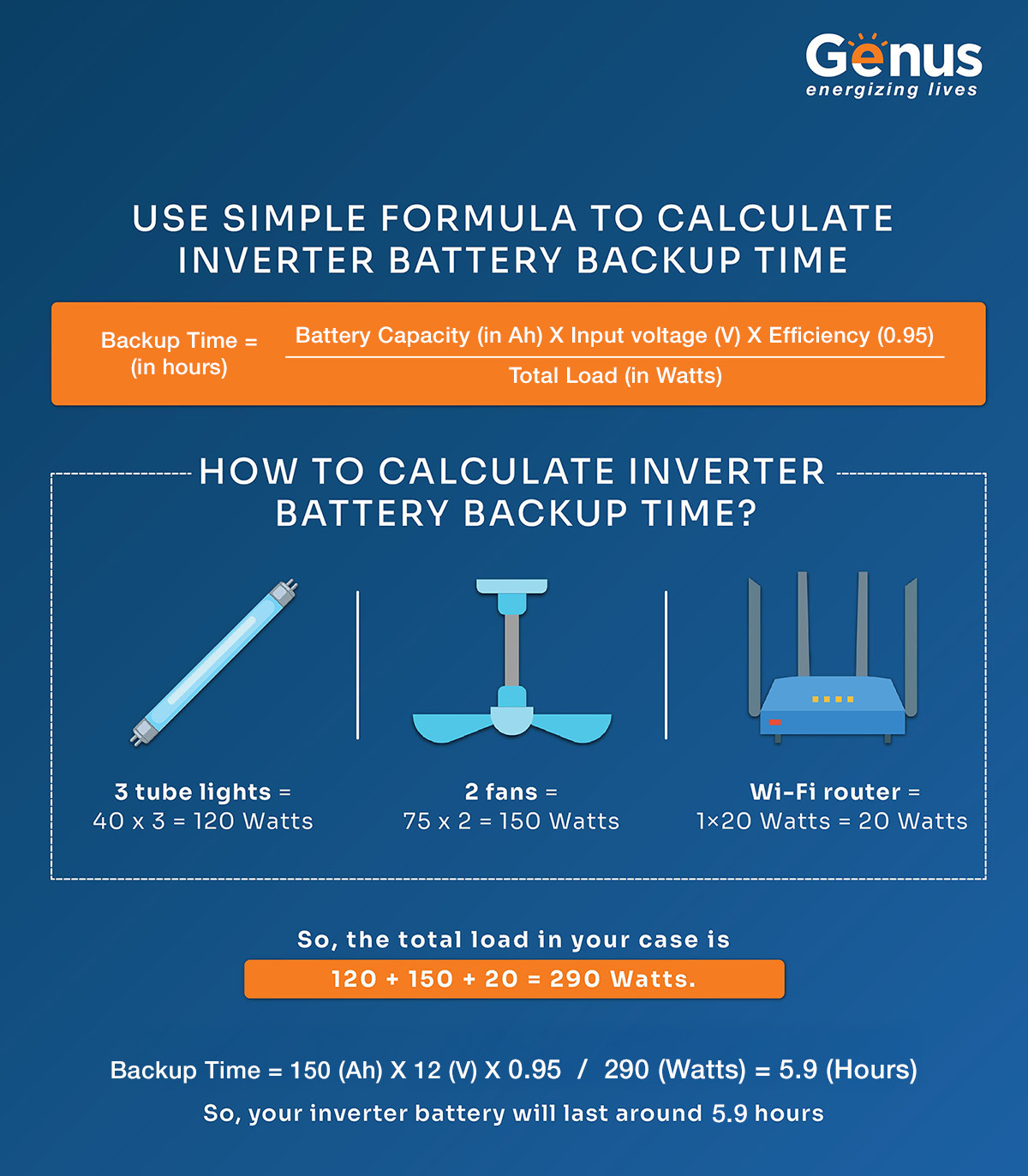 Total load:
3 tube lights = 40 x 3 =120 Watts
2 fans = 75 x 2 = 150 Watts
Wi-Fi Router = 20 x 1 = 20 Watt
Total load = 120 + 150 + 20 = 290 Watts
Now we will use the above-mentioned formula with all these values:
Backup time (in hours) = 150 x 12 x 0.95 / 290 = 5.9
So, in this example, the inverter battery can run the load of 2 fans and 3 tube lights and 1 Wi-Fi router for 5.9 hours.
Now, you know how to use the battery backup calculator so you can make the selection accordingly and get the inverter that can best match your power demands during an outage.
Also Read: A Guide to Choosing the Right Solar Battery
Total load:
3 tube lights = 40 x 3 =120 Watts
2 fans = 75 x 2 = 150 Watts
Wi-Fi Router = 20 x 1 = 20 Watt
Total load = 120 + 150 + 20 = 290 Watts
Now we will use the above-mentioned formula with all these values:
Backup time (in hours) = 150 x 12 x 0.95 / 290 = 5.9
So, in this example, the inverter battery can run the load of 2 fans and 3 tube lights and 1 Wi-Fi router for 5.9 hours.
Now, you know how to use the battery backup calculator so you can make the selection accordingly and get the inverter that can best match your power demands during an outage.
Also Read: A Guide to Choosing the Right Solar Battery
- What battery backup time means
- How to calculate it using a simple formula
- Tips to improve your inverter battery backup time
- Why choosing the right battery (like a lithium-ion inverter battery) makes all the difference
What is Battery backup time?
Battery backup time is the period for which an inverter can run the connected appliances during a power outage. There are 2 major factors on which it depends:- The battery capacity (Ah)
- Power consumption of connected devices running on inverter during power cut
How to calculate the inverter battery backup time?
Inverter battery backup time could be calculated using this simple formula: Backup time (in hours) = Battery capacity (Ah) * Input voltage (V) * Efficiency / Total load (W) In this formula:- Battery capacity is the Ampere hour rating of the battery (e.g. 150Ah, 200Ah)
- Battery voltage (which is usually 12V for a single Lead acid battery)
- Efficiency that is typically around 95% (0.95) for most of the inverters
- Total load is the total wattage of appliances connected to the inverter
Total load:
3 tube lights = 40 x 3 =120 Watts
2 fans = 75 x 2 = 150 Watts
Wi-Fi Router = 20 x 1 = 20 Watt
Total load = 120 + 150 + 20 = 290 Watts
Now we will use the above-mentioned formula with all these values:
Backup time (in hours) = 150 x 12 x 0.95 / 290 = 5.9
So, in this example, the inverter battery can run the load of 2 fans and 3 tube lights and 1 Wi-Fi router for 5.9 hours.
Now, you know how to use the battery backup calculator so you can make the selection accordingly and get the inverter that can best match your power demands during an outage.
Also Read: A Guide to Choosing the Right Solar Battery
Battery Capacity and Inverter Backup Time:
Does the backup time depend on the capacity of the battery? Of course, it does! Let us keep all the values same other than the battery capacity. Now, we will find out how to check inverter battery backup time considering both large and small battery capacities. If the battery capacity is 110Ah:- Backup Time (in hours) = 110 x 12 x 0.95 / 290 = 4.3 hours
- Backup Time (in hours) = 220 x 12 x 0.95 / 290 = 8.6 hours
Why does knowing the inverter backup time matter?
At the time of selecting the best inverter battery for your home or best inverter battery for the office, knowing the backup time helps you:- To avoid overloading the inverter during a power outage
- Choose the correct battery size
- Plan the appliances that you can use during a power cut
Factors that affect inverter battery backup time:
- The backup time is quickly reduced with the usage of high-power appliances such as microwaves, fridge etc.)
- Batteries that are poorly maintained or old may not provide a complete backup
- The type of inverter battery also plays a major role in backup time. Compared to traditional lead-acid batteries, lithium-ion inverter batteries usually last longer and charge faster too.
Tips to improve inverter battery backup time:
- Make use of energy-efficient appliances. You can choose things like energy-saving fans, LED lights etc.
- Switch to durable and reliable lithium-ion batteries that offer better performance as well
- Do not overload the inverter. You should take care of the load and avoid running several devices all at once
- The performance of the battery might be affected by corrosion and dirt so always keep the battery dry and clean
- Make sure to fully charge the battery since incomplete charging also shortens battery life
- In the case of lead-acid batteries, keep checking the water levels at regular intervals since low electrolyte levels can lead to problems
- Heat also reduces the efficiency of the battery so make sure to keep the inverter in a well-ventilated area
- Maintain regular servicing of your inverter by getting it checked by a technician


