


Generator v/s Inverter Back-up: Pros and Cons
Generator vs Inverter
| Principle | Diesel-run Generator (DG) | Inverter |
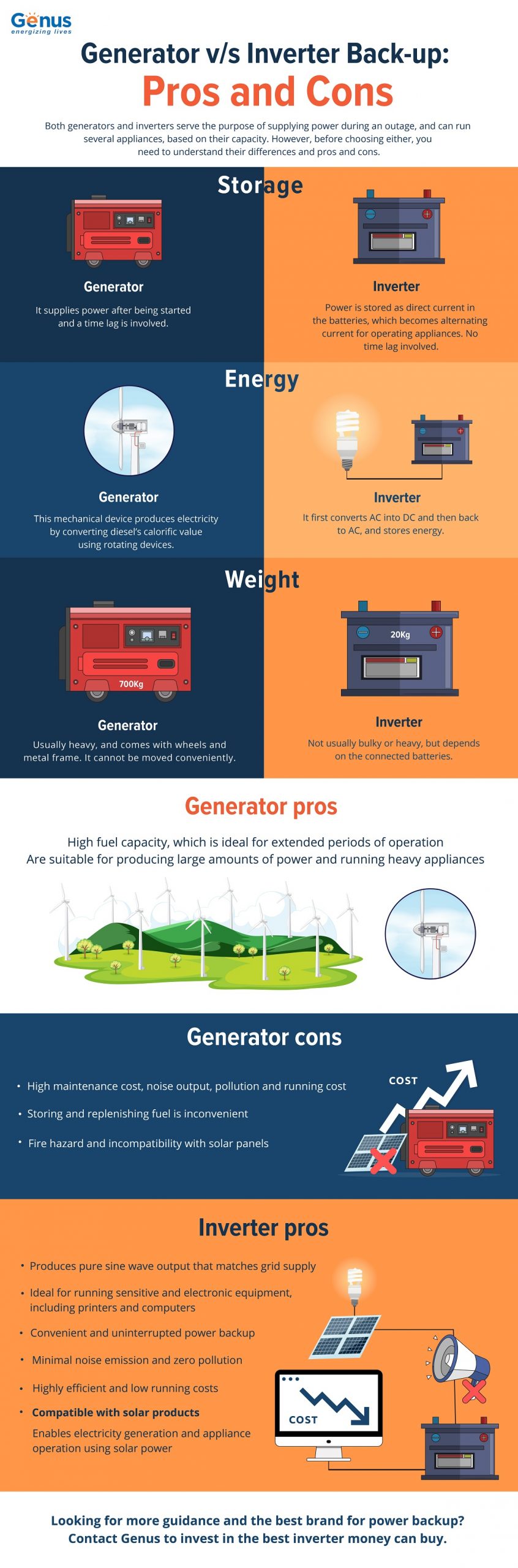
| Storage | A generator does not store electricity; as the name suggests, it generates electricity once started. So, it needs to be started first and only then will it provide power. Obviously, there will be a time lag between starting and receiving back-up power once utility supply fails. | A power inverter set does store power in the batteries in the form of direct current (DC). It first converts alternating current (AC) from the mains during charging and stores it; immediately reconverting it to AC to run your appliances. There is no time-interval; no manual starting either. |
| Energy | A generator generates electricity. It is a mechanical device that converts the calorific value of diesel into electrical energy using rotating devices. | An inverter only stores and reconverts energy. When DC power is converted into AC electricity, the result is an unvarying electrical signal. Properly filtered, it has the same characteristics as perfect alternating current. |
| Weight | Unless your power back up requirement is small (only domestic lighting and household appliances), a DG set can be heavy and bulky, requiring a metal frame and wheels. Technically, they are portable, but they lack the convenience factor. | An inverter is not a bulky, heavy device per se, but it works only along with a set of connected batteries. These can be bulky and not easy to shift around. |
| Maintenance | Generators work on diesel or gasoline to produce energy. They require dedicated maintenance with oil change, lubricant change, distilled water top-up and more in a periodic level. They produce more noise as well. | Inverters are good for maintenance. They don’t require a lot of looking after. Just make sure the water level is enough and the battery terminals are clean. |
Inverter vs Generator: Operation
What an Inverter does is that it uses a combination of switches and rectifiers to convert direct current into alternating current and vice versa. It requires a source of electrical energy to charge up the batteries and power on as soon as the main supply is cut off. The output wave is passed through a filter to smooth it out and give a stable current. A generator, on the other hand, turns mechanical energy into electrical energy. It is powered by diesel, gasoline or other combustible materials. When the fuel is burned, it rotates a motor which produces alternating magnetic fields inside the generator to ultimately generate electricity. The generator output might fluctuate while operating.Inverter vs Generator: Noise
Noise is an important factor that users take into consideration while comparing a generator vs inverter in India. Generators produce electricity through the motion of its engine, and it can get quite noisy. The motor needs to run at 3600 rpm typically, below which it won’t produce electricity efficiently. This rotation causes a lot of noise and it is difficult to subdue it as well. Inverters make use of smart microprocessors that can dampen the noise to a great extent internally. It analyzes the output connected and adjusts the amount of power produced, reducing any noise coming from the generator. Also Read: Best Ways to Charge Inverter Battery When You Don’t Have PowerInverter vs Generator: Cost
While generators produce more noise and use gasoline to operate, they are cheaper to buy than inverters. They are easy to repair as spare parts are widely available and it costs less to repair them as well. The smooth power flow, noiseless operation, compact design and other features drive up the price of inverters. Even the cheapest inverters are slightly more expensive than generators. However, the price is worth it.Diesel-run Generator Advantages:
- There is a reason why conventional generators are large and heavy. They have a higher fuel capacity. With more fuel, you can operate a standard generator for extended periods without running out of fuel.
- There is a stark contrast between the power output of a generator and an inverter. If you are operating heavier equipment and need a considerable amount of power, then rely on a generator to produce 500 watts up to 50,000 watts. So, if your job requires a lot of power and for a long time, a generator is a better solution.
Diesel-run Generator Disadvantages:
- Higher maintenance cost in the long run due to moving parts’ wear and tear
- Higher noise output
- Higher pollution due to use of fossil fuel
- Higher running cost due to (ever increasing cost of diesel) and relatively lower efficiency
- Inconvenience of replenishing and storing fuel
- Fire hazard of diesel storage—requires installation away from point of use
- Runs at the same speed of 3600 RPM, so you can expect the same noise even if fewer appliances are connected. It also costs higher when load requirements are less
- No compatibility with solar panels
Inverter Advantages:
- An inverter is safer for electronic devices and other sensitive equipment such as computers and personal printers. It produces a pure sine-wave output that matches the quality of mains supply.
- It provides uninterrupted back-up (critical, say, for a doctor’s clinic) with no starting time, no inconvenience either.
- Hardly makes any noise.
- Causes no pollution or is environment friendly.
- Greater efficiency of operation, and hence, lower running cost.
- The backup time is inversely proportional to load. The lower the load, higher the back-up time.
- The next generation inverters are designed for solar compatibility. Hence, you can generate electricity using solar power or run appliances or even charge batteries.
Difference between Generator and Inverter
Inverter or Generator: Which is Better for Home Use?
After weighing the advantages and disadvantages of using a battery inverter vs generator, it is up to you, the user, to decide which would be the best for your home. Generators produce a substantial amount of noise, but they can generate more power. They can be used to power up big appliances like fridge and ACs inside your home as well and their power backup lasts as long as you keep feeding them fuel. However, they can be bulky in design and use up a lot of space inside your home and are thus generally placed in discrete locations like under the stairs or inside the garage. Also Read: All You Need to Know About Running a Freezer on Solar Power On the other hand, inverters are compact in design, easier to run, and most importantly, run very quietly to make it a favorable buy for home consumers. They provide electricity by converting power stored in the batteries, and hence, switch on as soon as the main power supply is cut. No need for manual restart. They are available in different designs to suit the interior of your home but are unable to sustain the load of heavier appliances. For that, you might have to buy a more powerful inverter which could cost a lot.Difference between Generator and Inverter
 Genus is a reputed brand when it comes to power backup solutions of different types and capacities. So, if you are still confused about the inverter and generator difference, give us a call at +91 - 9667123456 and an expert will answer all your queries.
Share on
Previous Reading
6 Reasons Why You Shouldn’t Ignore...
Next Reading
2kw Solar Panel Systems in India-...